Home

The Tandem Tool for automated chemical kinetic model development





Documentation: T3 Documentation
Source Code: T3 Source
General
T3 is a tool for automatically generating refined kinetic models.
The key features are:
- Convenient: A single universal input file with an equivalent API, controlling all engines.
- Flexible: Supports all features of RMG and ARC, while maintaining reasonable defaults for simplicity.
- Structured: All outputs from all iterations are organized in an intuitive folder tree.
- Easy: Designed to be easy to use and learn.
- Robust: Captures lower-level exceptions, attempts to troubleshoot.
- Restartable: Has a convenient restart feature that's being triggered by identifying existing iteration outputs.
Principal workflow
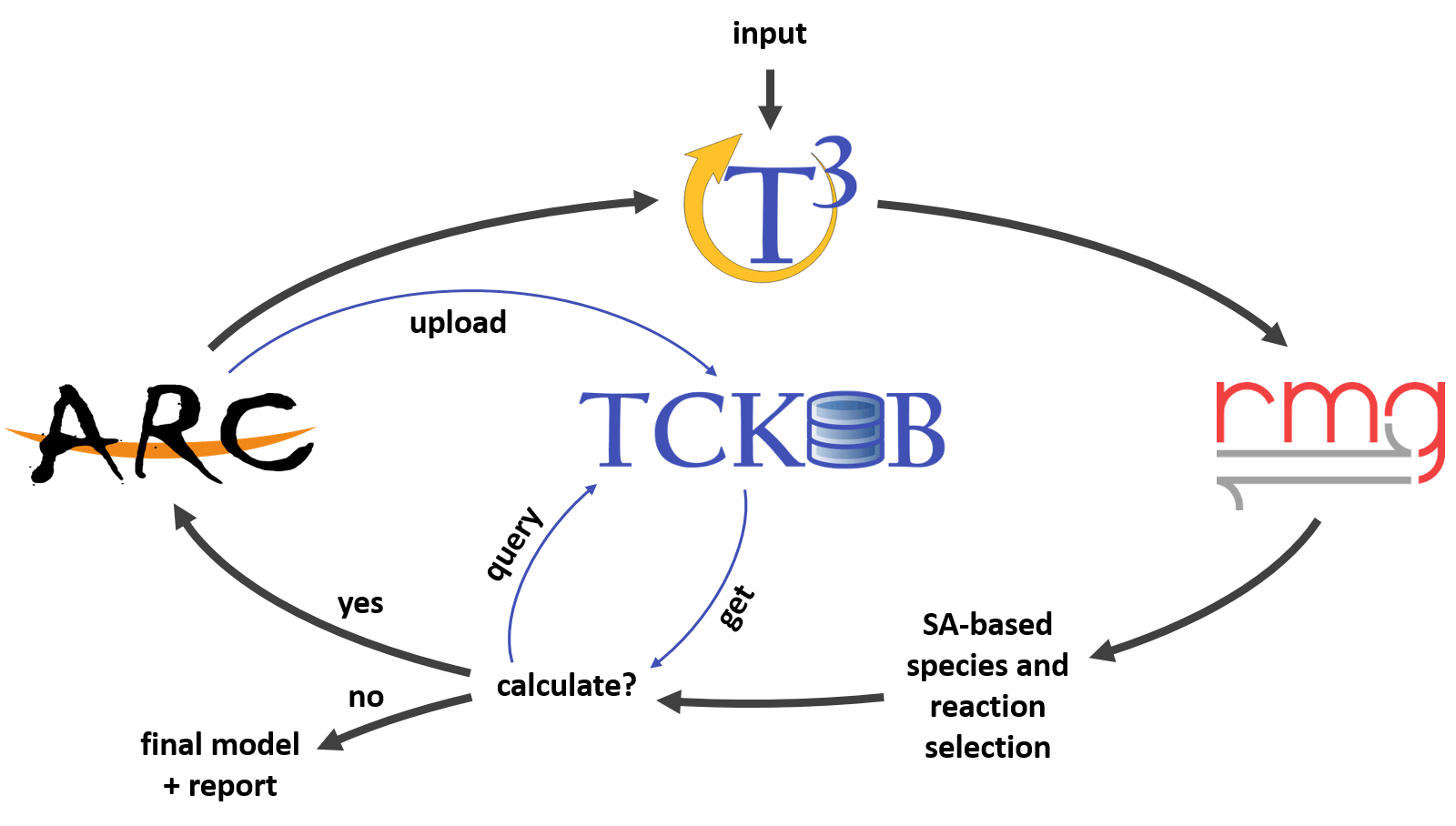
At its core, T3 iteratively calls RMG and an automated QM tool (currently supporting only ARC) to generate a kinetic model and refine it, respectively.
In each iteration:
- RMG generates a kinetic model using the specified mechanism generation parameters.
- T3 runs sensitivity analysis (SA) on the generated model to identify the most influential reactions and species.
- Species and reactions whose thermodynamic or kinetic parameters are uncertain and appear as important in the SA are sent to ARC for quantum mechanical calculation.
- The refined parameters are fed back into RMG for the next iteration.
The maximal number of iterations along with various control parameters can be determined by the user.
Quick start
After installation, activate the environment and run one of the examples:
conda activate t3_env
cd ~/Code/T3/examples/minimal
python -c "
from t3 import T3
import yaml

with open('input.yml') as f:
    args = yaml.safe_load(f)

t3_object = T3(**args)
t3_object.execute()
"
Or use the YAML input file directly:
python ~/Code/T3/T3.py input.yml
See the tutorials for step-by-step guides.
Intended audience
T3 is intended to be used by individuals with prior knowledge in chemical kinetic modeling, and some experience in electronic structure (quantum chemical) calculations. This documentation does not intend to provide advice for which levels of theory should be used for particular systems although examples with specific levels of theory are given.
Requirements
Python 3.12+
T3 stands on the shoulders of giants:
- RMG for model generation.
- ARC for automating electronic structure calculations.
- Cantera for mechanism simulation and sensitivity analysis.
License
This project is licensed under the terms of the MIT license.